
Zubcevic Lab Zubcevic Lab Interoceptive circuits in cardiovascular and brain health

Current research

How your gut talks to your heart.

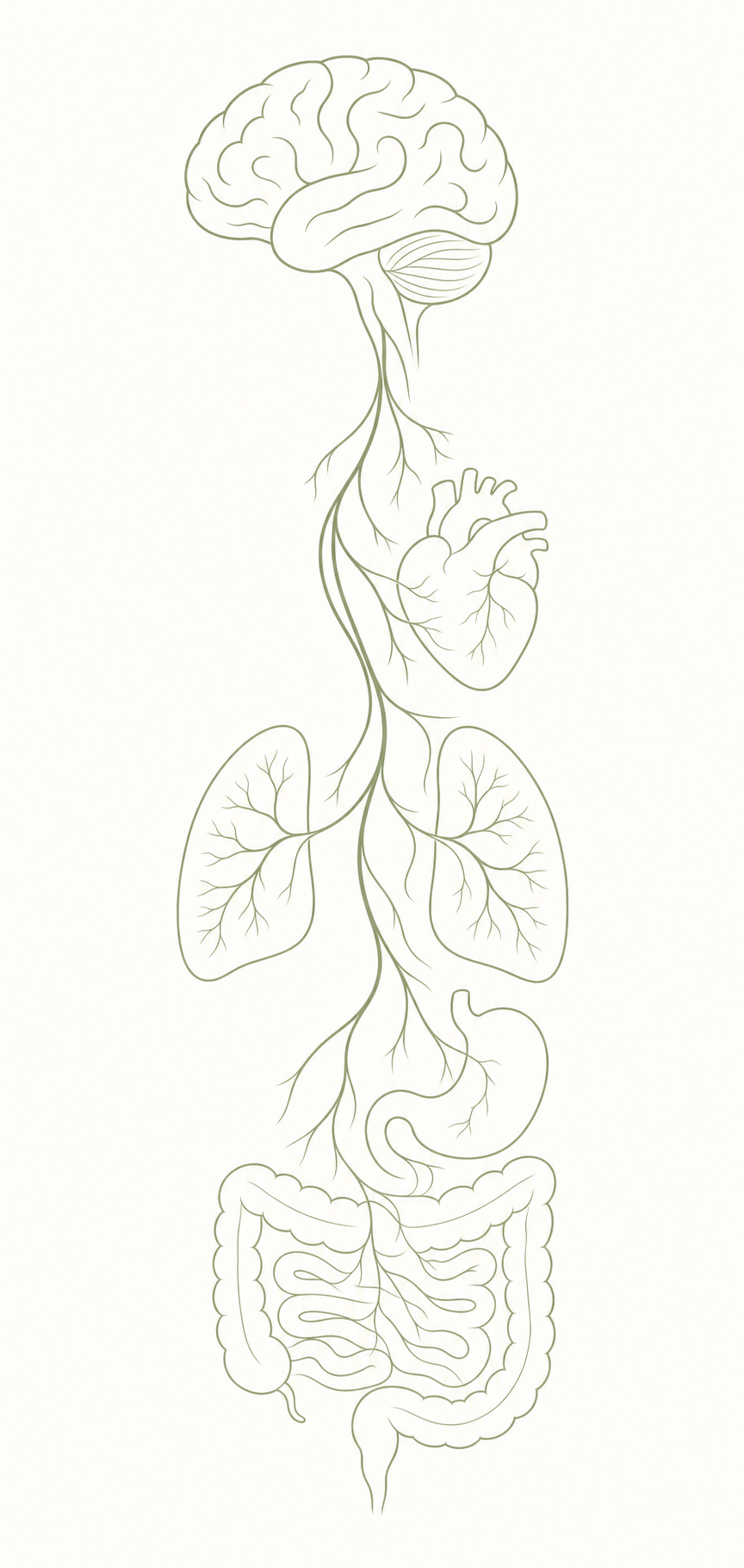
We study the interoceptive circuits — internal signals between body and brain — that regulate blood pressure every minute of every day. When that conversation breaks down, hypertension and comorbidities can follow.

Click a numbered dot on the illustration to step through the pathway.

Vagus nerve descending from brain through heart, lungs, stomach, and intestines

Based on de Araujo, Sree Kumar, Yang, Alviter Plata et al. (2024) · PMID 39314425  ·  Dirr, Jiracek, Baekey, Martyniuk, Otto, Zubcevic (2023) · PMID 37746712

Our Science

The arc of our work

Our lab has spent two decades following one question — how does the nervous system decide what blood pressure should be? — and each answer has opened the door to the next.

2008 – 2014

Where the brain sets blood pressure

We began at the autonomic root — the nucleus of the solitary tract (NTS), a tiny relay in the brainstem where baroreflex signals are read and blood pressure is set. Working in spontaneously hypertensive rats, we showed that PI3K signaling inside NTS neurons is rewired in hypertension: chronic blockade of NTS PI3K raised blood pressure, and angiotensin II shifted its signaling toward PI3K in hypertensive but not normal brains. A few years later we found the NTS (pro)renin receptor acts as a brake on this circuit, lowering blood pressure through an NF-κB–cytokine pathway. Together, these papers argued that NTS biology doesn't just reflect hypertension — it helps drive it.

2013 – 2019

The brain talks to the immune system

Following the autonomic signal downstream, we found it didn't stop at the heart and vasculature — it reached the bone marrow. We mapped functional neural–bone marrow pathways and showed that, in hypertensive animals, altered sympathetic drive to the marrow disturbs the immune cells made there. Pre-hypertensive rats already show abnormal bone marrow neural input and downstream inflammation, and bone marrow–derived cells then traffic back to the brain and vasculature to amplify the disease. This work reframed neurogenic hypertension as a neuro-immune-vascular disease, not a pure circuitry problem.

2015 – 2021

The gut microbiome in hypertension

With collaborators, we showed that gut dysbiosis tracks with high blood pressure in animals and humans. Removing β-adrenergic input to the marrow then reshaped the gut microbiota, increased short-chain fatty acid (SCFA) output, and quieted IL-17–driven colonic inflammation — directly linking sympathetic tone to microbial ecology. In hypertensive rats, butyrate absorption is impaired and its blood-pressure-lowering effects are blunted, and the gut wall itself shows pathological changes that track with disease severity. The autonomic–immune axis now had a clear microbial input.

2021 – present

The microbiota–gut–brain axis

All the pieces finally connected. We're now mapping the full microbiota → gut → vagus → brainstem → blood pressure circuit. Our recent research shows that intestinal serotonergic vagal signaling is a critical mediator of microbiota-induced hypertension. We've shown that subdiaphragmatic vagus nerve stimulation attenuates hypertension and rewires NTS transcriptional networks, and that gut-derived SCFAs directly tune cardiovascular tone in vivo. Our 2019 paper proposed an impaired ANS–microbiome circuit at the heart of hypertension; today, this is the model our active NIH-funded work tests, with the long-term goal of turning the microbiota into medicine for blood pressure.

Now — and next

Where we're heading

With the circuit mapped, our next chapter is about making it testable in human-relevant systems and moving the biology into people.

  1. Gut–vagal axis on a chip. In collaboration with bioengineers, we built a microfluidic gut–on–a–chip platform that reconstitutes the microbiota – gut enterochromaffin cell – vagal afferent interface in vitro. This platform — the focus of our NIH R21 HL179596 — lets us isolate how specific gut bacteria tune serotonergic vagal signaling, and screen the microbial inputs most likely to translate into new therapeutics for hypertension and other conditions associated with deregulated gut vagal signal.
  2. Translation in humans. We are extending the lab's findings into clinical populations through new collaborations with autonomic and cardiovascular physiologists like Manda Keller-Ross (University of Minnesota), Jeanie Park (Emory), and Vaughan Macefield (Monash University). Together, we are designing studies to test whether targeted probiotics can recalibrate autonomic function — sympathetic outflow, HRV, baroreflex sensitivity, and blood pressure control — in people living with cardiovascular disease.

Full publication list on PubMed and Google Scholar.

Tools we built

Open software from the lab

Research-grade tools we've built along the way that we share with the community.

Popular press & podcasts

The work in public

Conversations and coverage where our research has reached audiences beyond the journals.

The Team

Lab members

The people doing the work.

Jasenka Zubcevic, PhD

Jasenka Zubcevic, PhD

Principal Investigator

Associate Professor in the Department of Neurosurgery, Brain & Spine at the University of South Florida, with affiliations in the USF Microbiomes Institute and the Neuroscience Institute. PhD in Physiology from the University of Bristol (2008). PI of NIH R01 HL152162 and MPI of R21 HL179596, studying the autonomic and microbial control of cardiovascular function. Co-founder of Panthea Life, developing probiotic therapeutics for women's health.

Hemaa Sree Kumar, PhD

Hemaa Sree Kumar, PhD

Research Assistant

Recent PhD graduate (University of Toledo, 2025) whose doctoral work mapped serotonergic gut-brain signaling — how 5-HT released from enterochromaffin cells engages vagal 5-HT3a receptors to shape blood pressure.

Emily B. Otmanowski

Emily B. Otmanowski

MD/PhD Candidate · AHA Predoctoral Fellow

MD/PhD student investigating microbiota-gut-brain mechanisms of salt-sensitive hypertension and insulin resistance. Awarded the American Heart Association Predoctoral Fellowship in January 2026 (two-year) — scoring in the top <1% of awardees — for her project on host-microbiota interactions in cardiometabolic disease.

Adriana Alviter Plata

Adriana Alviter Plata

PhD Candidate

PhD candidate working on how gut bacteria shape lipid handling and cardiometabolic disease — including how immune-sympathetic crosstalk reorganises the gut microbiome and dietary lipid absorption.

Disclosure

Dr. Jasenka Zubcevic is a co-founder of Panthea Life, a biotech company focused on women's health with a patent-pending probiotic therapeutic.

Panthea